

Visiting Akrotiri, Santorini’s Bronze Age Town: Tickets, Hours and Tips (2026)
Updated October 2026 · Written by the Santorini Day Tours local team
Short answer: Akrotiri is a Bronze Age town on the south of Santorini that was buried under volcanic ash by the island’s great eruption about 3,600 years ago and is now one of the best-preserved prehistoric sites in Europe. A full ticket costs €20 (reduced €10), most visits take 60–90 minutes, and the whole site is under a roof, so it can be visited even in midday heat. It is about 12 km from Fira, roughly 20 minutes by car. Opening hours change through the season, so check the official ticket site before you go.
Tickets and opening hours (2026)
| Details | |
|---|---|
| Full ticket | €20 |
| Reduced ticket | €10 (eligible groups) |
| Free entry (examples) | EU citizens under 25; non-EU visitors under 18; several free-admission days each year |
| Summer hours | Generally from 8:00 am to early evening; shorter hours (8:30 am–3:30 pm) on Mondays and Thursdays; closing times move earlier from September |
| Time needed | 60–90 minutes |
| Where to buy | At the entrance or online on the official Greek ticketing site, hhticket.gr |
Free-admission days have included 6 March, 18 April, 18 May, the last weekend of September, 28 October, and the first and third Sunday of each month from November to March. Hours and free days are set by the Greek Ministry of Culture and can change, so confirm them for your date on the official site.
What you will see
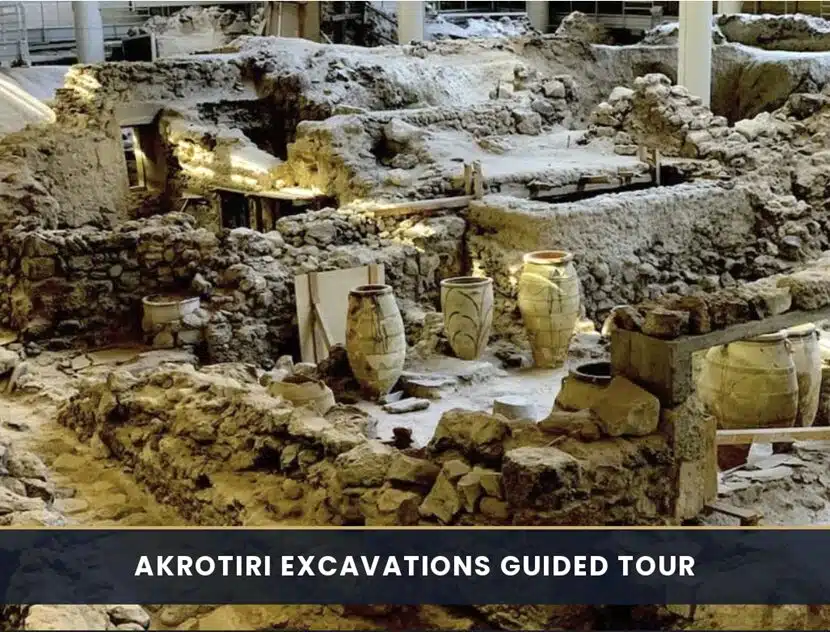
Akrotiri was a wealthy harbour town linked to Minoan Crete. Its people left before the eruption — almost no human remains or valuables have been found, which suggests they had warning — and the ash then preserved the town up to its upper floors. Walking the raised walkways you see:
- Streets and squares with buildings two and three storeys high, some with staircases still in place.
- Storage jars (pithoi) still standing where they were left, and traces of a drainage system.
- Furniture casts made by pouring plaster into the hollows left by wooden beds and tables.
- Fresco fragments in place — the famous wall paintings, such as the Spring fresco and the Fisherman, were removed for conservation and are displayed in museums, several in the National Archaeological Museum in Athens and others in the Museum of Prehistoric Thera in Fira.
Systematic excavation began in 1967 under the archaeologist Spyridon Marinatos, and only part of the town has been uncovered. Many visitors know Akrotiri through the theory linking it with Plato’s story of Atlantis — an idea your guide can explain, though historians treat it as a legend rather than a fact.
Do you need a guide?
We recommend one. The site has few explanatory signs, and without context it can look like a field of walls. In Greece, tours inside archaeological sites are given by licensed guides, so a private driver usually drops you at the entrance rather than guiding you inside. Our Ancient Akrotiri and Santorini wineries tour includes a one-hour guided visit with a professional guide, the admission ticket, and then three wineries with a sommelier — 6 hours, departing at 9:30 am, from €800 for one or two guests and €250 per person for groups of four to six.
How to get there
- By private tour: any of our private tours can include a stop at Akrotiri, for example the 5-hour Best of Santorini or the 8-hour Amazing Santorini tour. Admission is paid separately unless the tour page says it is included.
- By bus: KTEL buses run from Fira to Akrotiri; the stop is opposite the entrance.
- By car: about 20 minutes from Fira and 40–45 minutes from Oia, with a car park opposite the entrance.
Tips from local guides
- Go early or late in summer. The roof gives shade but the site is not air-conditioned; mornings and late afternoons are the most comfortable, and quieter than the late-morning cruise-tour rush.
- Combine it with the south. Red Beach, the Akrotiri lighthouse and the wineries around Megalochori are all close. Red Beach has had rockfall restrictions in recent years, so view it from the official viewpoint and follow the signs.
- See the frescoes too. Visit the Museum of Prehistoric Thera in Fira after the site to see the wall paintings and objects found at Akrotiri.
- Families: under-18s from outside the EU and EU citizens under 25 enter free. More ideas in Santorini with kids.
Frequently asked questions
How much is the Akrotiri ticket in 2026?
€20 for a full ticket and €10 for a reduced ticket. Some visitors, including EU citizens under 25 and non-EU visitors under 18, enter free.
How long do you need at Akrotiri?
Between 60 and 90 minutes for most visitors; allow the full 90 minutes with a guide.
Is Akrotiri worth visiting?
Yes, if you have any interest in history. It is a whole Bronze Age town preserved by volcanic ash, and it is covered, so it works even in summer heat.
Is Akrotiri the same as Ancient Thera?
No. Akrotiri is the prehistoric town in the south of the island. Ancient Thera is a much later Greek and Roman city on the mountain above Kamari.
Can I visit Akrotiri from a cruise ship?
Yes. It is about 20 minutes from Fira by car, so a private tour can fit Akrotiri into a port day. See our Santorini cruise port guide for timing.
Was Akrotiri the lost city of Atlantis?
Some people connect Akrotiri with Plato’s Atlantis story, but there is no evidence that Plato was describing it. Historians treat Atlantis as a legend.